
For years, brands relied on static personalization. This usually meant inserting a first name into an email subject line or retargeting a user with the exact pair of shoes they just bought. But according to recent data, effectiveness of these purchase-history-based recommendations has dropped by 24%. Consumers now view this as “lazy” personalization at best, and intrusive at worst.

The landscape has shifted from static to agentic.
Modern customer journey personalization isn’t about what a brand shows a customer. It’s about when and why. It is the era of the autonomous agent where AI doesn’t just assist, but actively orchestrates the journey in real-time based on intent, sentiment, and context.
This guide covers the strategy, data, and tools teams need to move beyond basic segmentation and build a personalization engine that actually drives revenue.
Table of Contents
- What is customer journey personalization?
- The Data You Need for Personalized Customer Journeys
- Customer Journey Personalization Tactics That Work Now
- Where to Apply Customer Journey Personalization
- How to Test, Measure, and Iterate Customer Journey Personalization
- Frequently Asked Questions About Customer Journey Personalization
What is customer journey personalization?
Customer journey personalization tailors experiences across all stages of the customer lifecycle, from the first anonymous website visit to the post-purchase support ticket. It is the continuous, real-time orchestration of touchpoints where, nowadays, AI agents autonomously adjust interactions based on live behavioral signals.
It’s different from basic personalization because it adapts the experience, not just the message. Basic personalization is often static and relies on rigid rules, like inserting a personalization token like “Hi [Name]” into a generic email blast. Customer journey personalization is agentic and contextual. It uses real-time signals, including location, weather, support status, or recent page views, to adapt the entire experience dynamically. HubSpot’s Breeze AI Suite powers real-time customer journey orchestration and AI-driven decisions, allowing the system to change the next step based on what the customer just did, rather than following a preset path.
Unlike single-channel tactics, such as a tailored email subject line or a dynamic ad, journey-level personalization connects the dots between marketing, sales, and service. It ensures that if a customer complains about a product on a support ticket today, they aren’t pitched an upgrade for that same product in a marketing email tomorrow. This holistic view is the only way to build genuine trust in a digital-first world.
The Shift to Agentic Personalization
The definition has tightened in 2026. It is no longer enough to manually build linear “if/then” rules. We are now in the era of agentic personalization, where AI agents like Breeze monitor the “messy middle” of the buyer’s journey.
The new way is agentic orchestration. An agent effectively says, “The customer is on the pricing page, but their recent support ticket sentiment is ‘Frustrated.’ Do not send the standard sales email. Instead, alert a human success manager immediately.” This ability to pause, pivot, and personalize based on real-time context is what separates modern revenue teams from legacy ones.
Expected Outcomes
When executed correctly, the agentic personalization approach solves the “Empathy Paradox.” HubSpot research suggests that using AI allows teams to be more human, not less. By using AI to handle robotic tasks, humans can focus on connection.
- 70% ticket deflection. HubSpot customer Camp Network is using Breeze to resolve routine queries instantly, without human intervention. This frees up human agents to handle complex, emotional issues.
- Higher retention. Churn can be reduced by predicting friction before the customer signals it. If usage drops, the system intervenes before the cancellation request comes in.
- Increased revenue. Driving cross-sells through high-trust, context-aware recommendations is far more effective than “spray and pray” tactics. There are undeniable advantages to using personalized content, primarily the lift in conversion rates.
Pro tip: Do not confuse “personalization” with “customization.” Customization is when a user manually sets their preferences, such as selecting dark mode or notification settings. Personalization psychology relies on anticipating needs without the user asking.
The Data You Need for Personalized Customer Journeys
First-party data enables real-time, privacy-compliant personalization. With third-party cookies rapidly declining, brands must build transparent value exchange models and rely on the data customers share directly.
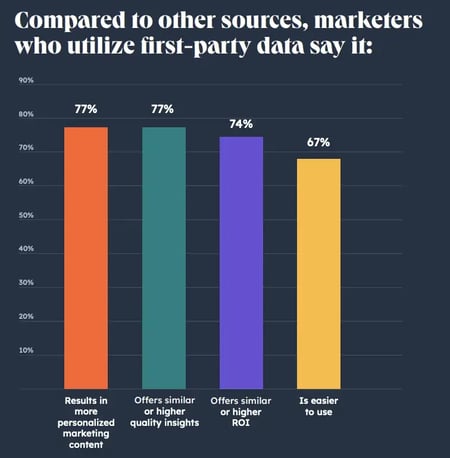
HubSpot Smart CRM unifies customer profiles and first-party data across marketing, sales, and service. This eliminates costly fragmentation and ensures teams are not personalizing from disconnected systems.
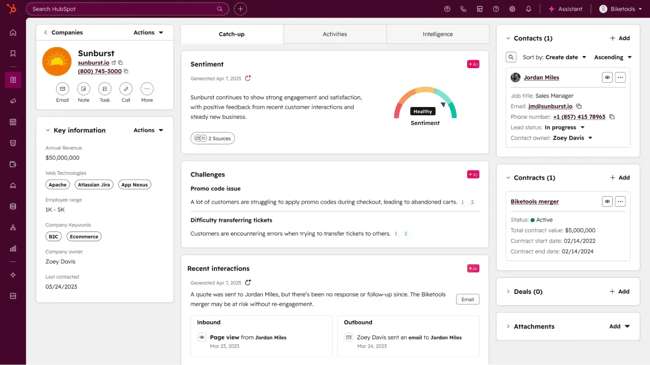
Teams should begin with the five data types below.
1. Identity Data (The “Who”)
This is the foundation. You cannot personalize for a ghost. Personalizing the customer journey without using third-party cookies requires a strategic shift toward Zero-Party Data and First-Party Data. Brands must replace invisible tracking with a transparent “value exchange” strategy, asking customers directly for their preferences via progressive forms. Furthermore, HubSpot’s Breeze enables the “de-anonymization” of visitors based on IP addresses and verified company data. This technology allows revenue teams to personalize experiences using company firmographics and intent signals without ever needing to track the user across external sites.
Teams need to collect clear firmographic and demographic signals, including name, role, company size, tech stack, and location. This matters because it allows for “de-anonymization.” Identifying that a visitor is from “Ford Motor Co” allows marketers to instantly swap their homepage case studies to automotive examples. This creates immediate relevance and dramatically lowers bounce rates.
2. Zero-Party Data (The “Gold Standard”)
Third-party cookies are a liability in 2026. Zero-party data is data that a customer intentionally shares with a company in exchange for value. This is the highest quality data a brand can own because it comes directly from the source with explicit consent.
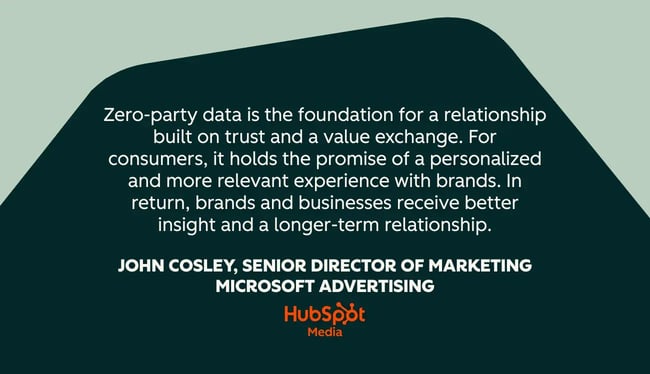
Teams should aim to collect responses to high-value questions like “What is your biggest challenge?” or “I am buying this for…”. The best way to do this is through progressive profiling. Instead of presenting a lead with a massive form, ask one relevant question per visit. Over time, teams build a rich, detailed profile without ever creating friction. And it works: 83% of consumers are willing to share this data if it leads to a truly personalized experience.
3. Intent Data (The “What”)
This is behavioral data captured directly by a company’s systems. It reveals what a prospect is interested in based on their actions, not just their words.
Focus on collecting high-intent page views, such as repeated visits to pricing or cancellation policy pages, and webinar attendance and email clicks.
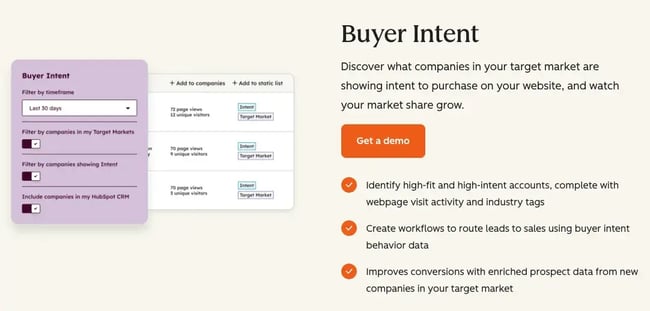
Pro tip: Look for velocity. A prospect visiting the pricing page once is interested. A prospect visiting it three times in one hour is a signal for immediate agentic outreach. Velocity is often a stronger signal of purchase readiness than simple volume.
4. Contextual Data (The “History”)
This is the history of interactions stored in the Service Hub timeline. It provides the narrative arc of a brand’s relationship with the customer.
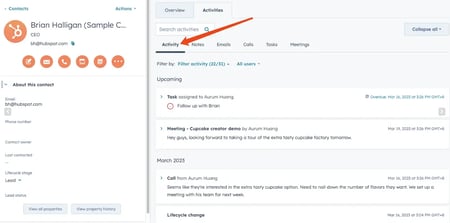
Teams must collect open support tickets, chat transcripts, onboarding status, and recent NPS scores. This eliminates the “context collapse” that customers feel when one team has no idea what the other is doing. No organization should be pitching an expansion to a customer who is actively struggling with a “P1” issue. Contextual data protects trust by aligning timing with the customer’s reality, making every interaction feel informed and relevant.
5. Sentiment Data (The “Emotion”)
AI assists with predictive insights and dynamic content generation by analyzing the tone of the customer interaction, not just the keywords.
Collect sentiment analysis from email replies, call recordings, and chat logs. The application here is powerful: If sentiment drops to “Negative,” service teams can automatically route the customer away from the AI bot and directly to a human agent. This “sentiment-based routing” is a key feature of the modern help desk.
Internal resource: Personalized customer service guidance
Here’s how sentiment analysis might appear in conversation-level interactions.
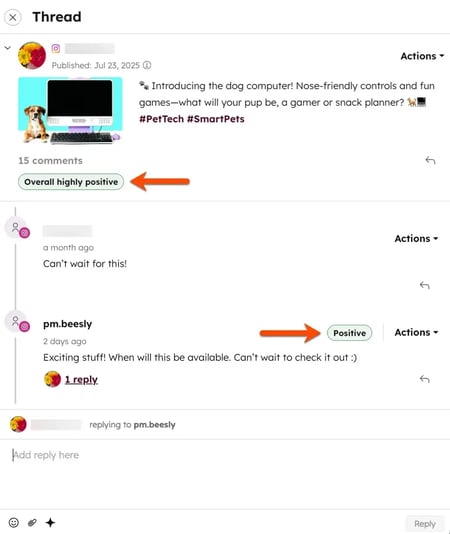
Overall, teams should not wait for perfect data quality. The most important step is unifying existing insights into a Smart CRM so journey orchestration can begin.
Customer Journey Personalization Tactics That Work Now
The highest-impact personalization opportunities align with lifecycle transitions. Specifically:
- Anonymous to known during acquisition.
- Sales to Service during onboarding.
- Service to Success during expansion and renewals.
HubSpot’s Marketing Hub activates personalized experiences across web, ads, and email. Service Hub enables personalization in support and post-purchase journeys. Breeze AI Suite powers context-driven automation across both.
Below are seven proven tactics for customer journey personalization, mapped to the customer lifecycle.
1. The “De-Anonymized” Welcome (Acquisition)
Stop treating every website visitor like a stranger. Most B2B traffic is anonymous, but that doesn’t mean it’s unrecognizable. Use Breeze Intelligence to identify the company behind the IP address. This happens instantly on the first page load. It reduces bounce rates significantly without requiring a login or a form fill. It immediately signals the visitor that they are in the right place.
The Tactic: If a visitor arrives from a known software company, dynamically change the H1 headline from “Solutions for Everyone” to “Solutions for SaaS Leaders.”
Lifecycle Stage: Visitor/Lead.
Why it works: This is the highest leverage point for acquisition. A business removes the cognitive load of the visitor having to ask, “Is this for me?” By mirroring their industry immediately, you create an implicit bond of understanding. (See more website personalization examples).
2. Agentic Content Remixing (Consideration)
Blog posts shouldn’t just sit there. Content personalization tools allow websites to adapt the format to the user. Static content libraries are obsolete, and dynamic content libraries are the new standard.
The most effective approach for the consideration stage is to use the Content Agent in HubSpot Content Hub. This tool allows marketers to remix a high-performing case study into a personalized landing page for a specific prospect segment. Marketers can take one core asset and spin it into five industry-specific variations in minutes, effectively tailoring the narrative for Marketing Qualified Leads (MQLs).
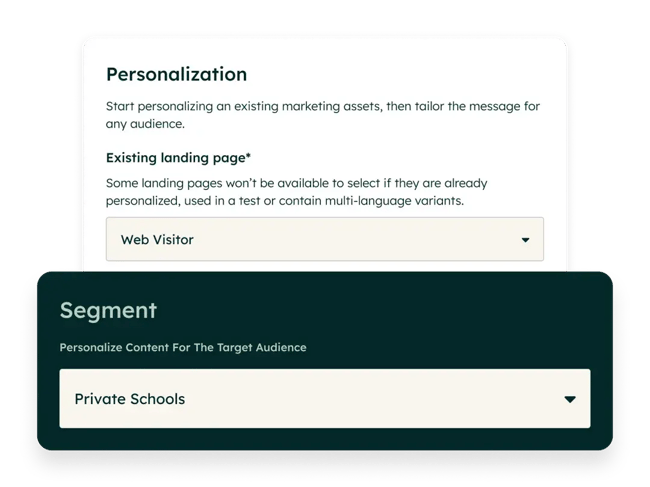
The Tactic: Use the Content Agent to automatically generate industry-specific landing pages from a single core asset.
Lifecycle Stage: Marketing Qualified Lead (MQL).
Best for: Scaling Account-Based Marketing (ABM) programs without adding headcount. This allows a small marketing team to appear as if they have vertical-specific expertise across dozens of industries.
3. The “Ghosting” Nudge (Sales)
When a high-value prospect goes silent, generic follow-ups like “Just checking in” often fail. They offer no value and simply add noise to the inbox. HubSpot customer Sandler saw a 50% reduction in sales cycle time by using AI agents to hyper-personalize outreach rather than relying on generic templates.
“As marketers, we’re always looking for ways to be more efficient, more personalized, and more scalable. Breeze has really been our ticket to do that,” shared Emily Davidson, director of enterprise marketing at Sandler.
The Tactic: Use HubSpot’s Prospecting Agent to draft a hyper-personalized email referencing a recent news event for that prospect’s company. For example, “Saw you just opened a new office in Austin…” implies sales representatives are paying attention.
Lifecycle Stage: Sales Qualified Lead (SQL).
Case Study Stat: 50% reduction in sales cycle time (Sandler Case Study). The agent can scan thousands of data points in seconds, something a human BDR simply cannot do at scale, to find the one “hook” that re-engages the prospect.
4. The Contextual Handoff (Onboarding)
The most dangerous moment in the customer journey is the handoff from Sales to Service. Information is often lost, forcing the customer to repeat their goals and pain points. Automate this summary creation to trigger immediately when the deal stage moves to “Closed Won.” This ensures the service team is prepped before the first onboarding call.
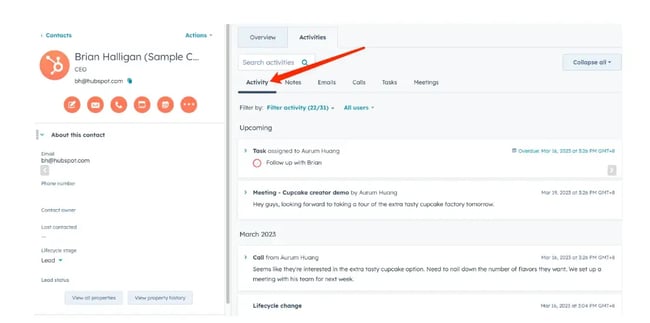
The Tactic: Use Breeze Assistant to generate a “Conversation Summary” of the entire sales process. When the Onboarding Manager opens the account, they see a bulleted list of the client’s goals and pain points. The client never has to repeat themselves.
Lifecycle Stage: Customer (New).
Pro tip: Include the client’s preferred communication channel in this summary to start the relationship on their terms. If they preferred video calls during the sales cycle, don’t force them into an email thread for onboarding.
5. Autonomous Resolution (Retention)
For routine queries, speed now trumps high-touch service for most customers. The HubSpot State of Service Report showed that 78% of customers prefer self-service, prioritizing instant resolution over human interaction. Breeze lets service teams deploy AI agents to manage this. Customers can interact with the Breeze Customer Agent to get personalized customer service tailored to their problem, rather than searching through FAQs. It turns support from a cost center into a retention engine.
The Tactic: Deploy the Breeze Customer Agent on the help desk or other pages. Train it on the company knowledge base to resolve all “Tier 1” issues autonomously, 24/7.
Lifecycle Stage: Customer (Active).
Why it matters: It shifts human agents to high-value consulting work. Instead of resetting passwords, humans can focus on “Tier 2” and “Tier 3” issues that require complex problem-solving and emotional intelligence, which drives higher job satisfaction and customer loyalty.
6. Sentiment-Based Routing (Support)
Not all support tickets are equal. A frustrated customer requires a different path than a confused one. HubSpot Service Hub uses Breeze Intelligence to detect sentiment instantly. This ensures high-emotion tickets are fast-tracked to humans, giving agents the full context – or the “temperature of the room” – before they even say hello.
The Tactic: In the help desk, set up a workflow that triggers when sentiment is “Negative.” Bypass the AI agent entirely and route this directly to a qualified human agent, perhaps a retention specialist.
Lifecycle Stage: Customer (At Risk).
What I like: It prevents “bot loops” that enrage already frustrated customers. By routing them to a human agent empowered to solve the problem immediately, teams turn a potential detractor into a promoter.
7. Predictive Engagement (Growth)
Don’t wait for the renewal date to reach out. By then, it’s often too late to save a disengaged customer or upsell a happy one.
The Tactic: Instead of a generic email sequence, use Breeze Intelligence to detect “usage gaps” (e.g., a healthy customer ignoring a key feature). Then, trigger a Customer Agent to proactively ping them via in-app chat with a specific, helpful resource, OR have Breeze Copilot draft a hyper-personalized note for the Customer Success Manager to review and send.
Lifecycle Stage: Evangelist / Brand Advocate (Renewal).
Result: Drives Net Dollar Retention (NDR) by solving problems before the customer asks. It shifts the dynamic from “checking in” to “adding value.”
Where to Apply Customer Journey Personalization
Journey orchestration coordinates channels, teams, and systems for the next best actions. With Smart CRM and Breeze AI, customers receive seamless guidance instead of conflicting outreach, no matter which team executes the touchpoint.
|
Lifecycle Stage |
Personalization Tactic |
Real-Time Trigger Signal |
AI-Orchestrated Action |
HubSpot Product |
|
Acquisition |
De-Anonymized Welcome |
Company identified via IP |
Smart Content dynamically personalizes homepage messaging |
Breeze Intelligence + CMS Hub |
|
Consideration |
Agentic Content Remixing |
Industry or role detected from browsing behavior |
Content Hub generates and displays segment-specific content |
Content Hub + Smart CRM |
|
Sales |
“Ghosting” Nudge |
No reply > 7 days or high-intent browsing resume |
Prospecting Agent drafts context-aware outreach using recent company news |
Sales tools + Prospecting Agent |
|
Onboarding |
Contextual Handoff |
Deal moves to Closed-Won |
Breeze Copilot summarizes goals, risks, and preferences for the onboarding team |
Service Hub + Breeze Copilot |
|
Service |
Autonomous Resolution |
Tier-1 FAQ detected in chat or ticket |
Breeze Customer Agent resolves instantly and logs the outcome |
Service Hub + Breeze Customer Agent |
|
At-Risk Customers |
Sentiment-Based Routing |
AI detects negative sentiment |
Escalate directly to a human retention specialist with sentiment insight |
Service Hub + Breeze Intelligence |
|
Success / Growth |
Predictive Engagement |
High value potential but low feature adoption |
Proactive enablement message or CSM follow-up |
Smart CRM + Marketing Hub |
Historically, personalization was a marketing KPI. In 2026, true customer journey orchestration lives at the intersection of all teams, making revenue operations (RevOps) the natural owner of the strategy.
While marketing creates the content, sales manages the relationships, and service resolves the issues, RevOps needs to own the “governance” — the data model, the decision logic, and the rules of engagement.
The most effective way to start small is to personalize just one high-leverage moment in the journey, such as when a visitor becomes known or when a new customer begins onboarding. Automating even a single “next best action” trigger in HubSpot, like adapting homepage content by industry or routing negative sentiment directly to a senior agent, creates measurable lift quickly. Once that initial win is proven with metrics like lower bounce rate or faster time-to-value, replicate the orchestration pattern across the rest of the lifecycle. Scale comes from expanding what works, not launching everything at once.
How to Test, Measure, and Iterate Customer Journey Personalization
In 2026, personalization success is measured by impact, not impressions. Open rate and click rate alone no longer reflect whether customers experienced less friction or achieved value faster. To understand what is truly working, organizations need measurement systems built on trustworthy data. HubSpot Data Hub supports data quality, sync, and workflow automation. It ensures that performance reporting is consistent across teams by maintaining data hygiene, cross-system sync, and automated lifecycle tracking.
A strong ROI model evaluates both efficiency and revenue acceleration. Efficiency improvements come from automation, such as the number of inquiries fully resolved by AI instead of humans. Revenue impact is measured by comparing pipeline velocity and close rates between leads who experience personalized interactions and those who do not. True ROI blends these two outcomes: money saved plus revenue gained, minus the cost of the tools powering the engine.
Ticket Deflection Rate
This is the clearest measure of whether personalization is eliminating unnecessary support effort. When customers resolve routine issues instantly, teams avoid backlogs and preserve human attention for higher-value interactions.
What it is: The percentage of incoming inquiries fully resolved by the Breeze Customer Agent without human involvement.
How to measure: Use Service Hub’s Customer Agent performance reporting to track AI-resolved tickets divided by total incoming tickets. HubSpot performance data indicates that many organizations are already seeing 60% to 70% of inbound questions resolved automatically when the agent has access to a strong knowledge base.
What to do after: Review unresolved requests weekly. These will often reveal where content is missing, user intent is unclear, or sentiment requires human escalation. Updating knowledge base content and improving decision rules increases future deflection while maintaining customer satisfaction.
Time-to-Value (TTV)
This indicates whether personalization is successfully accelerating time to first value. When customers achieve a meaningful milestone quickly, confidence rises, and churn risk decreases.
What it is: The number of days between a deal moving to closed-won and the customer achieving their first success moment, such as launching a first workflow or activating a key product feature.
How to measure: Start by defining a single, visible milestone that represents value realization for new customers. Use timestamps to measure the period from signup to that milestone.
There are two common methods:
- With HubSpot. Track onboarding progress and activation events directly within Data Hub. Timestamps are automatically recorded as lifecycle properties update and workflows execute.
- Without HubSpot. Pull contract date and activation event timestamps from the product analytics platform (such as Mixpanel or Amplitude) and calculate the difference through a dashboard or business intelligence tool.
Both methods help teams analyze which onboarding steps speed up progress and which steps create unnecessary friction.
What to do after: Identify the stages where customers commonly stall. Personalize onboarding based on user role, product tier, and intent signals — delivering the right training or guidance at the right moment. When TTV improves, product stickiness follows.
Customer Acquisition Cost (CAC) Payback Period
This metric shows whether the personalized customer journeys accelerate revenue or shorten the path to profitability. Efficient personalization should help recover acquisition costs faster and improve margins.
What it is: The time required for the revenue generated by a new customer to cover the cost of acquiring them, factoring in cost of sales, marketing, and onboarding.
How to measure: Segment customers into cohorts: those exposed to personalized journey flows versus those who went through standard nurture. Then compare average time to break-even per cohort, accounting for sales cost, onboarding resources, and any ongoing support overhead.
Research on AI-assisted sales shows that sales teams using AI tools are 3.7 times more likely to meet quota than peers who do not — demonstrating how contextual, data-driven outreach improves conversion efficiency and revenue velocity.
What to do after: Take a look at the fastest “payback” cases. Identify which personalized triggers drove conversion and value. Was it timing, content, channel, or context? Embed those triggers into the orchestration logic so future leads follow the same high-efficiency path. Continuously optimize based on cohort performance.
By systematically tracking Ticket Deflection Rate, TTV, and CAC Payback Period using real-world data and verifiable benchmarks, teams can:
- Demonstrate efficiency gains through AI-enabled automation.
- Show that personalization speeds up a customer’s time-to-value.
- Prove that personalization reduces acquisition cost or accelerates payback.
- Build a repeatable, data-driven growth engine.
Treat these metrics as an ongoing improvement cycle, not a one-time evaluation. Optimize anything that slows progress. Scales what drives measurable impact. Over time, personalization becomes a core driver of operational performance and sustainable revenue growth, not just a customer experience enhancement.
Frequently Asked Questions About Customer Journey Personalization
How do you personalize a customer journey without third-party cookies?
Personalizing the customer journey without third-party cookies requires a strategic shift toward zero-party data and first-party data. Brands need to replace invisible tracking with a transparent “value exchange” strategy, asking customers directly for their preferences via progressive forms.
HubSpot’s Breeze Intelligence enables the “de-anonymization” of visitors based on IP addresses and verified company data. This allows revenue teams to personalize experiences using company firmographics and intent signals without ever needing to track the user across external sites.
What data do you need to start journey personalization?
The data required to start customer journey personalization relies on a unified Smart CRM foundation that collects three specific layers of information. Identity Data is essential to establish who the customer is, often using enriched profiles from Breeze Intelligence. Intent Data captures what the customer is doing in the moment, such as high-intent page visits or specific clicks.
Finally, Contextual Data tracks the historical narrative, including support tickets and sales calls. Teams should not wait for perfect data hygiene but should begin orchestrating journeys with the data currently available in their CRM.
What is the difference between personalization and journey orchestration?
Customer journey personalization differs fundamentally from basic personalization by moving beyond static, rule-based tactics. While basic personalization relies on inserting fixed data points (also called personalization tokens) like a first name into a subject line, journey orchestration is agentic and contextual.
Personalizationleverages the Breeze AI Suite to power real-time decisions, using live signals such as location, weather, support status, or recent page views to dynamically adapt the entire experience. This allows the system to determine the next best action based on immediate customer behavior rather than a rigid, linear path.
How do you measure the ROI of customer journey personalization?
Measuring the ROI of customer journey personalization involves tracking both efficiency and revenue metrics. Efficiency is measured by calculating cost savings from the Ticket Deflection Rate, such as multiplying the number of AI-resolved tickets by the cost per human resolution.
Revenue impact is tracked by analyzing Pipeline Velocity and Deal Close Rate for leads nurtured with personalized content versus those who received generic outreach. The net ROI is derived by adding the value of deflected tickets and the revenue lift from personalized upsells, then subtracting the cost of the AI tooling.
Deliver personalization that drives growth, not guesswork.
Customer expectations have surpassed simple personalization. Today’s buyers expect every digital interaction to feel relevant, timely, and connected. Customer journey personalization fulfills that demand by tailoring experiences across the full lifecycle using real-time behavior, first-party data, and AI-powered orchestration. The results are measurable: lower friction, higher engagement, improved retention, and more efficient revenue growth.
To execute at this level, organizations need a unified customer record, trusted automation, and intelligent tools capable of adapting in the moment. HubSpot delivers this through Smart CRM, Marketing Hub, Service Hub, Data Hub, and the Breeze AI Suite. Together, they transform isolated touchpoints into a coordinated, context-aware journey that scales.
If your team is ready to move beyond static tactics and build a personalization engine that drives business outcomes, HubSpot provides the foundation to start quickly and grow with confidence. See how real-time journey personalization works in practice. Get a demo.

